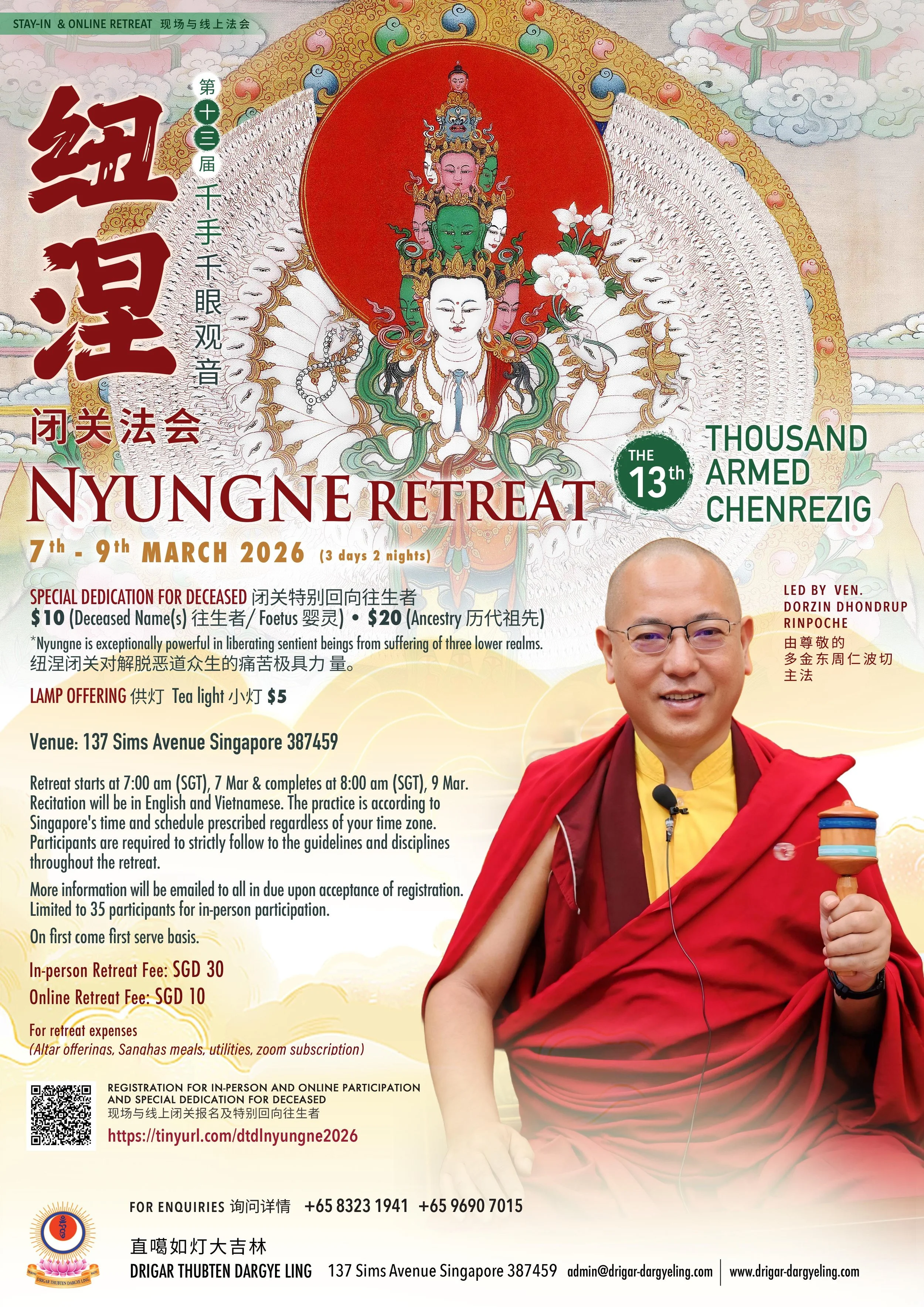
Ven. Dorzin Dhondrup Rinpoche will be leading the 13th Thousand Armed Chenrezig Nyungne Retreat from 7th to 9th March 2026 (3 days, 2 nights), which is open for both stay-in and online participation.
The Nyungne Retreat is an austere practice of fasting based on the supplication to Lord Chenrezig in his thousand-armed form. This practice is known to be a powerful method for karma purification, merit accumulation, pacifying obstacles on the path to enlightenment, and enhancing one's spiritual advancement.
The Retreat was revealed by Gelongma Palmo, who was believed to be a princess of Oddiyana before renouncing the palace and becoming a fully ordained nun. Despite being extremely learned and endowed with extraordinary beauty, she was later afflicted with the dreadful disease of leprosy.
However, through rigorous and intensive ascetic practices of fasting, recitations, and meditation on Avalokiteshvara, she was able to cure her leprosy and become a great siddhi.
𝗪𝗵𝗮𝘁 𝗶𝘀 𝗡𝘆𝘂𝗻𝗴𝗻𝗲 𝗥𝗲𝘁𝗿𝗲𝗮𝘁? The Nyungne Retreat is a two-and-a-half-day practice that revolves around mantra recitation, prostration, and meditation on the Eleven-faced, Thousand-armed Chenrezig. The word Nyungne can be translated as "abiding in the fast."
On the first day of the retreat, at early dawn, the master will bestow The Eight Precepts (Sojong), which restores (so) all positivities and purifies (jong) all negativity. After receiving the precepts, all participants are encouraged to focus their body, speech, and mind on prostration, mantra recitation, and meditation.
Participants are permitted to have one vegetarian meal (without garlic and onions, etc.) by midday on the first day. After that, no solid food is allowed, although drinking is still permitted.
The second day of the retreat is the actual fasting day, during which one must continue the practice without food or drink for 24 hours, strictly observing the Eight Precepts and refraining from talking. The fasting period ends at early dawn on the third day, followed by traditional rituals of making offerings and prayers.
During the retreat, the recitation will be conducted in Tibetan, English and Vietnamese.